Story
An Enemy to Rome
Swear never to be the friend of the Romans.
Polybius 3.11, in W. R. Paton's 1922 translation. Hannibal, years later at the court of Antiochus, tells this as the oath his father required when he was nine. Livy 21.1, in D. Spillan's 1849 translation, introduces a matching story with the words "There is besides a story," and the oath there is "to prove himself, as soon as he could, an enemy to the Roman people." The two reports do not use the same sentence. "Aut viam inveniam aut faciam" is not this oath and is not a secured ancient quotation of Hannibal.
No post link has been added yet. When a cut is published, it will be listed here. The accounts are Instagram, X, YouTube, Pinterest.
The story
Before the Second Punic War, Hannibal’s father Hamilcar was taking a Carthaginian army to Spain. Hannibal was a child. Two ancient histories tell what happened at the sacrifice, and they do not tell it the same way.
Livy, at the start of Book 21, is about to narrate the war and pauses for what he calls a story. Spillan’s 1849 translation says that Hannibal, about nine, coaxed his father to take him along. He was led to the altar, laid his hand on the offerings, and was bound by an oath to prove himself, as soon as he could, an enemy to the Roman people. Livy’s frame is fama: a story in circulation, not a document he claims to have seen.
Polybius puts the memory in Hannibal’s own mouth, much later. Hannibal is at the court of Antiochus, and the king has grown suspicious of him. Paton’s 1922 translation has him say that he was nine, standing by the altar while Hamilcar sacrificed, and that after he begged to go to Spain his father led him up and ordered him to lay his hand on the victim and swear never to be the friend of the Romans. He tells Antiochus the point of repeating it: while the king means to fight Rome, Hannibal can be trusted; if the king makes peace, he should beware of him.
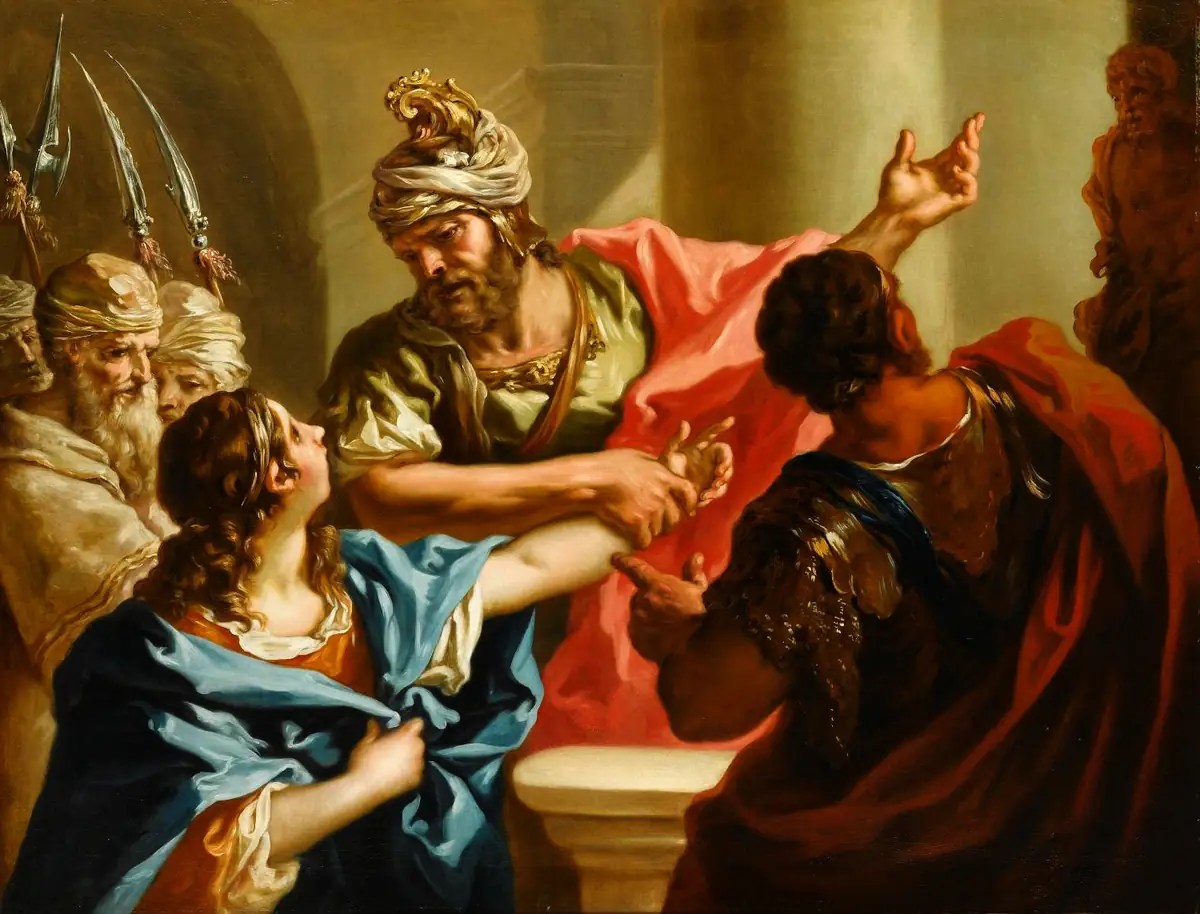
One version says “an enemy to the Roman people.” The other says “never to be the friend of the Romans.” One is introduced as a story. The other is a speech told years afterward, when Hannibal needed a suspicious king to believe him. Pellegrini’s canvas of 1731 paints the altar and the boy. The war that followed is the one in which Archimedes was killed at Syracuse, in 212, while Hannibal was still in Italy. The slogan “I will find a way or make one” is not this oath, and it is not a line either author records.
The artwork
The Young Hannibal Swears Enmity to Rome · Giovanni Antonio Pellegrini, 1731
Giovanni Antonio Pellegrini painted The Young Hannibal Swears Enmity to Rome in 1731. A boy stands at an altar beside his father while an army waits. It is an eighteenth-century illustration of the oath story in Livy and Polybius. It is not a Carthaginian image, and it is not a portrait of Hannibal.
The Commons description of the file retells Livy's version. The canvas follows that scene. It cannot show which of the two ancient wordings was spoken, because neither author was there with a transcript.
Giovanni Antonio Pellegrini, The Young Hannibal Swears Enmity to Rome, 1731. Oil on canvas, private collection. Public-domain painting; reproduction via Wikimedia Commons. Image file. Public domain. The painting is free of known copyright restrictions. Artist Giovanni Antonio Pellegrini died in 1741. A faithful reproduction of a two-dimensional public-domain artwork is treated as public domain in the United States; other countries may restrict reuse of the photograph.

Sources
- Polybius, Histories 3.11, translated by W. R. PatonPublic-domain Loeb translation, 1922. LacusCurtius text of Book 3. Hannibal tells the oath at Antiochus's court.
- Livy, History of Rome, Book 21, chapter 1, translated by D. SpillanPublic-domain translation, Henry G. Bohn, 1849. Livy marks the oath as a story.
- Wikimedia Commons file for Pellegrini's painting
More like this
The Die Is Cast
The die is cast.
Do Not Disturb My Circles
Do not disturb my circles.
Supreme Excellence Is Not the Battle
Hence to fight and conquer in all your battles is not supreme excellence; supreme excellence consists in breaking the enemy's resistance without fighting.
I Will Not Steal a Victory
I will not steal a victory.
Come and Take Them
Come and take them.
Now I Am My Own Master
Now I am my own master.