Story
We Suffer More Often in Imagination
There are more things, Lucilius, likely to frighten us than there are to crush us; we suffer more often in imagination than in reality.
The second clause is often quoted alone. Both clauses are Letter 13, section 4, in Richard M. Gummere's 1917 translation. They are not last words, and they do not describe the death Nero later ordered.
No post link has been added yet. When a cut is published, it will be listed here. The accounts are Instagram, X, YouTube, Pinterest.
The story
Seneca wrote this to Lucilius in the Moral Letters to Lucilius. Letter 13 is titled, in Richard M. Gummere’s translation, “On Groundless Fears.” The sentence quoted above is section 4. Gummere’s English was published in 1917 and is in the public domain in the United States.
Seneca tells Lucilius that he is not using the harshest Stoic voice here. He says the school likes to call the things that make people groan unimportant, and that those large words may be true, but that he and Lucilius can set them down for a moment. The advice he actually gives is narrower: do not be unhappy before the crisis comes. The danger you are picturing may never arrive. It has not arrived yet.
He then sorts the mistake into three habits. Some things torment us more than they should. Some torment us before they should. Some torment us when they should not torment us at all. His name for the habit is exaggerating, imagining, or anticipating sorrow. Later in the letter he tells Lucilius to ask whether other people’s alarm is about a real evil or about rumor, and whether he is turning something that is not an evil into one.
The letters belong to his last years. He had tried to leave Nero’s court in 62. He was ordered to die in 65. Letter 13 sits early in the collection, inside that window. An exact day is not known. Nothing in the letter says he is describing his own execution, and the sentence is not a set of last words.
The painting is the other story, the one Tacitus tells about 65. Nero ordered the death after the Pisonian conspiracy. Tacitus’s account is the one Rubens paints: an old man whose blood will not flow quickly, surrounded by people who are there to watch him die. Read the letter as a warning about fear rehearsed in advance. Read the panel as a picture of the death that came later. Putting the quotation into Seneca’s mouth in the basin is a later invention, and this page does not do it.
The artwork
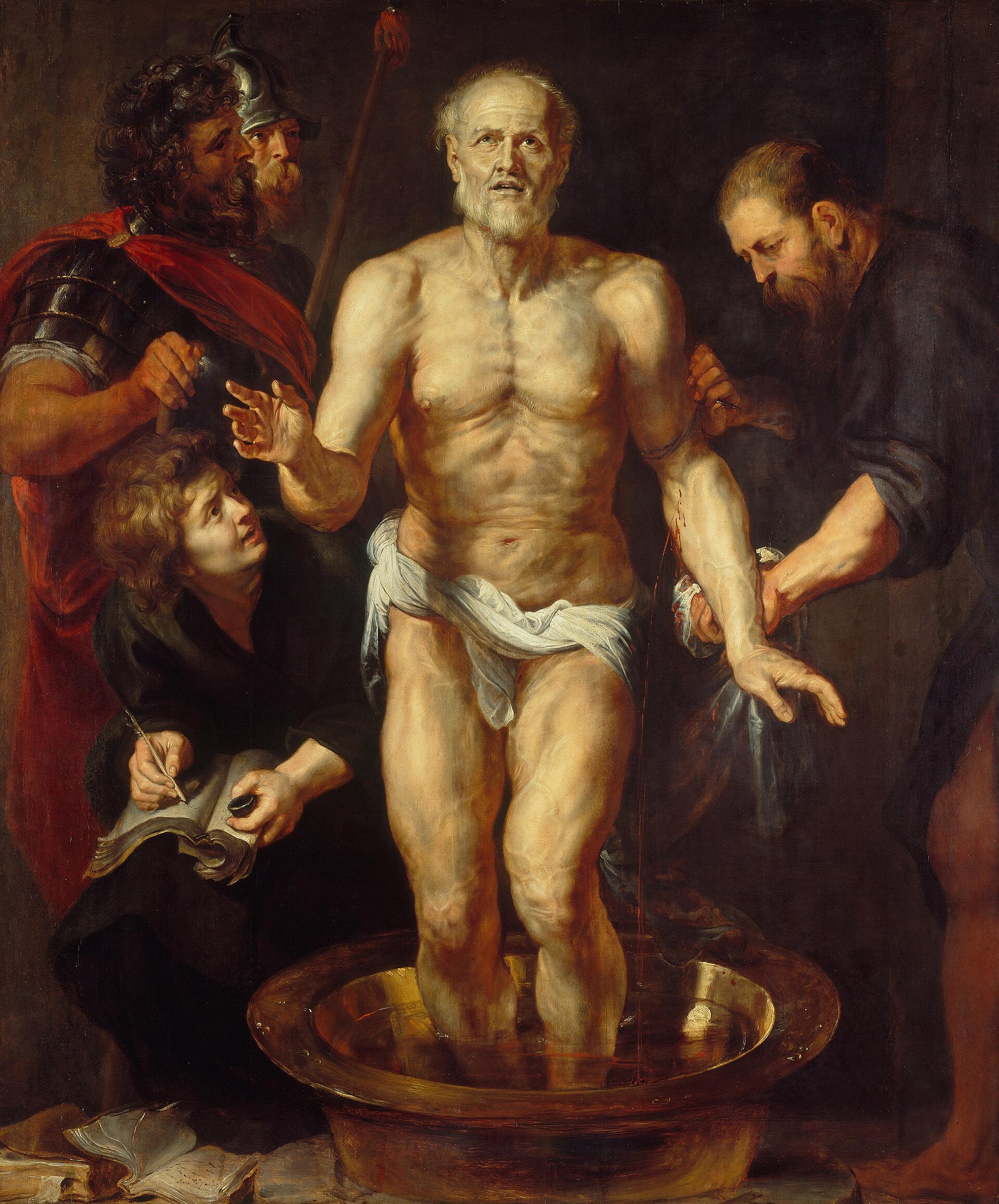
The Dying Seneca · Peter Paul Rubens, c. 1612–1613
Rubens painted The Dying Seneca around 1612 to 1613. The panel is in the Alte Pinakothek in Munich, inventory number 305. Seneca stands in a basin while his veins are opened. Pupils and attendants crowd the dark around him. The body is built like an ancient statue: long, strained, and idealized.
The scene follows the death Tacitus describes in Annals 15, not the letter quoted on this page. In 65, after the Pisonian conspiracy, Nero ordered Seneca to kill himself. Tacitus says the bleeding from his arms was slow, that he also cut the veins in his legs, that he drank hemlock, and that he died in a hot bath. His wife, Pompeia Paulina, tried to die with him and was stopped on Nero's orders. Rubens chooses the opening of the veins, the moment painters usually choose. He does not paint the hemlock or the bath.
This is not a portrait from life. Rubens worked about fifteen centuries after Seneca died, and about two centuries before the Roman double herm now associated with Seneca was found in 1813. A famous ancient bust long called Seneca is now usually treated as someone else, the so-called Pseudo-Seneca. The face in this panel is a seventeenth-century image of a death scene.
Peter Paul Rubens, The Dying Seneca, about 1612–1613. Oil on panel, 185 × 154.7 cm. Alte Pinakothek, Munich, inv. 305. Public-domain painting; reproduction via Wikimedia Commons. Image file. Public domain. The painting is free of known copyright restrictions. Wikimedia treats a faithful reproduction of a two-dimensional public-domain artwork as public domain in the United States; other countries may restrict reuse of the photograph.

Sources
- Seneca, Moral Letters to Lucilius, Letter 13, translated by Richard M. GummerePublic-domain translation, Loeb edition, 1917. The quotation is section 4.
- Tacitus, Annals, Book 15, translated by Church and BrodribbThe forced suicide of 65 CE is told from chapter 60 onward. Public-domain translation.
- Alte Pinakothek collection record
- Wikimedia Commons file for Rubens's The Dying Seneca
More like this
It Is Not the Thing That Disturbs You
If thou art pained by any external thing, it is not this thing that disturbs thee, but thy own judgment about it. And it is in thy power to wipe out this judgment now.
Supreme Excellence Is Not the Battle
Hence to fight and conquer in all your battles is not supreme excellence; supreme excellence consists in breaking the enemy's resistance without fighting.