Person
Marcus Aurelius
Roman emperor from 161 to 180, and the author of the private Stoic notebooks later called Meditations.
Life
Marcus Annius Verus was born in Rome on 26 April 121. His father died while he was a child, and he was raised under his grandfather’s eye. Hadrian marked him for the succession, and Antoninus Pius adopted him. He became emperor on 7 March 161, at first sharing the office with Lucius Verus. Verus died in 169. From 177 his son Commodus ruled with him.
Much of the reign was spent at war. A Parthian campaign occupied the east. The Antonine Plague came back with that army and ran on for years. On the Danube he fought a long series of wars against peoples including the Marcomanni. He died on 17 March 180, still on that frontier. Cassius Dio gives the date. The town is disputed: later Latin writers name Vindobona, modern Vienna, and another tradition names Sirmium. Dio also reports a rumor that physicians hastened the death for Commodus’s sake. The rumor is not treated here as fact.
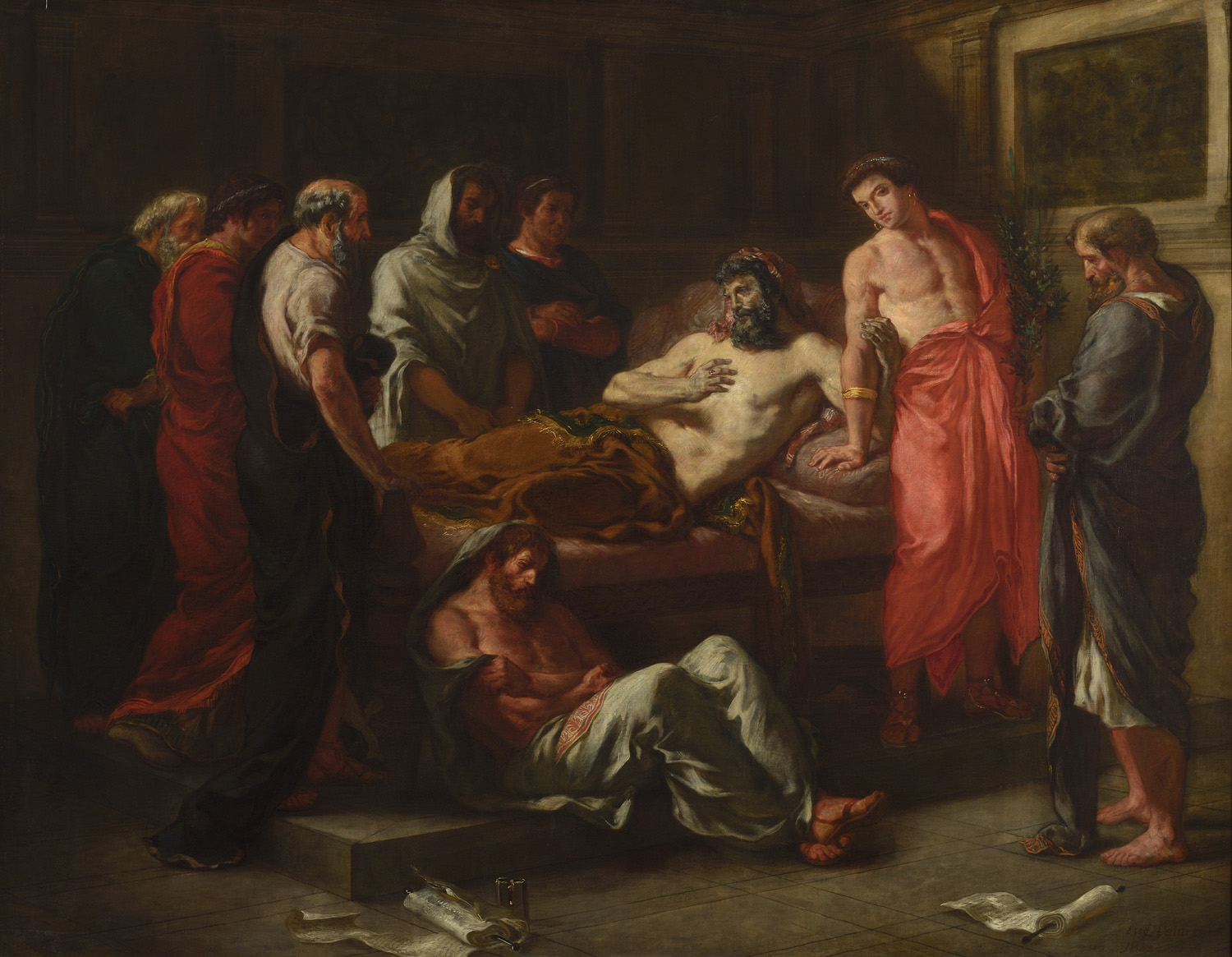
The notebooks called Meditations were written in Greek during the later years, for himself rather than for a public. They were not a memoir of the wars, and individual sections are hard to date. What survives of his public image from antiquity is sculpture: portrait busts, and the bronze equestrian statue that stood in Rome. The picture on this page is Eugène Delacroix’s canvas of 1844, an imagined deathbed, not one of those portraits.
Eugène Delacroix, Last Words of the Emperor Marcus Aurelius, 1844. Musée des Beaux-Arts de Lyon. This is a nineteenth-century history painting, not a Roman portrait. Public-domain reproduction via Wikimedia Commons. Image file. Public domain. See the Commons file for the reproduction status outside the United States.
