Person
Galileo Galilei
Astronomer and mathematician. He abjured before the Holy Office on 22 June 1633. The sentence "Eppur si muove" is a later legend, not a line in that record.
Life
Galileo Galilei was born in Pisa on 15 February 1564. He taught mathematics, built telescopes, and published observations of the Moon, the moons of Jupiter, and the phases of Venus. In 1632 he published the Dialogue Concerning the Two Chief World Systems, a book that put the Copernican case in a conversation the censors had not approved in that form.
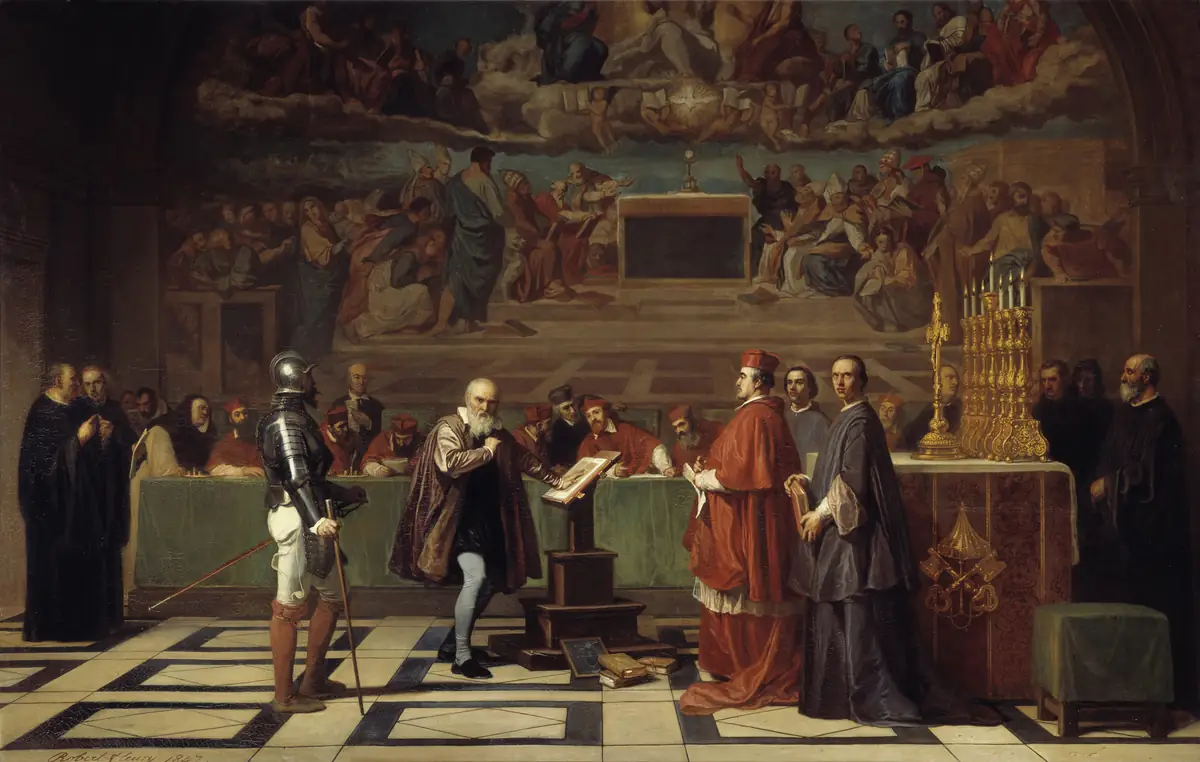
In Rome, on 22 June 1633, he abjured before the Holy Office. The text he accepted denies that the earth moves. He spent the rest of his life under restriction at Arcetri, near Florence, and died there on 8 January 1642. The words Eppur si muove (“still it moves,” in Giuseppe Baretti’s English of 1757) are not in the abjuration and not in a report from that day. Baretti’s Italian Library is an early printed English version of the legend, and the same paragraph adds torture and a six-year imprisonment that the trial record does not support. The picture on this page is Joseph-Nicolas Robert-Fleury’s canvas of 1847, a later hall of judges. It is not a document, and it is not a portrait from life.
Joseph-Nicolas Robert-Fleury, Galileo before the Holy Office, 1847. A nineteenth-century history painting, not a likeness from 1633. Public-domain reproduction via Wikimedia Commons. Image file. Public domain. See the Commons file for the reproduction status outside the United States.
