Person
Cato the Younger
Roman senator and Stoic who died at Utica in 46 BCE after Caesar's victory at Thapsus. That night he read Plato's Phaedo. "Now I am my own master" was said when the sword was returned, not as a last word.
Life
Marcus Porcius Cato, called the Younger to keep him distinct from his great-grandfather, was born in 95 BCE. He made a political career out of refusing compromises he thought corrupt, and he took the Stoic teachers seriously enough that later Romans treated him as the pattern of a Stoic senator. He fought on the republican side against Caesar.
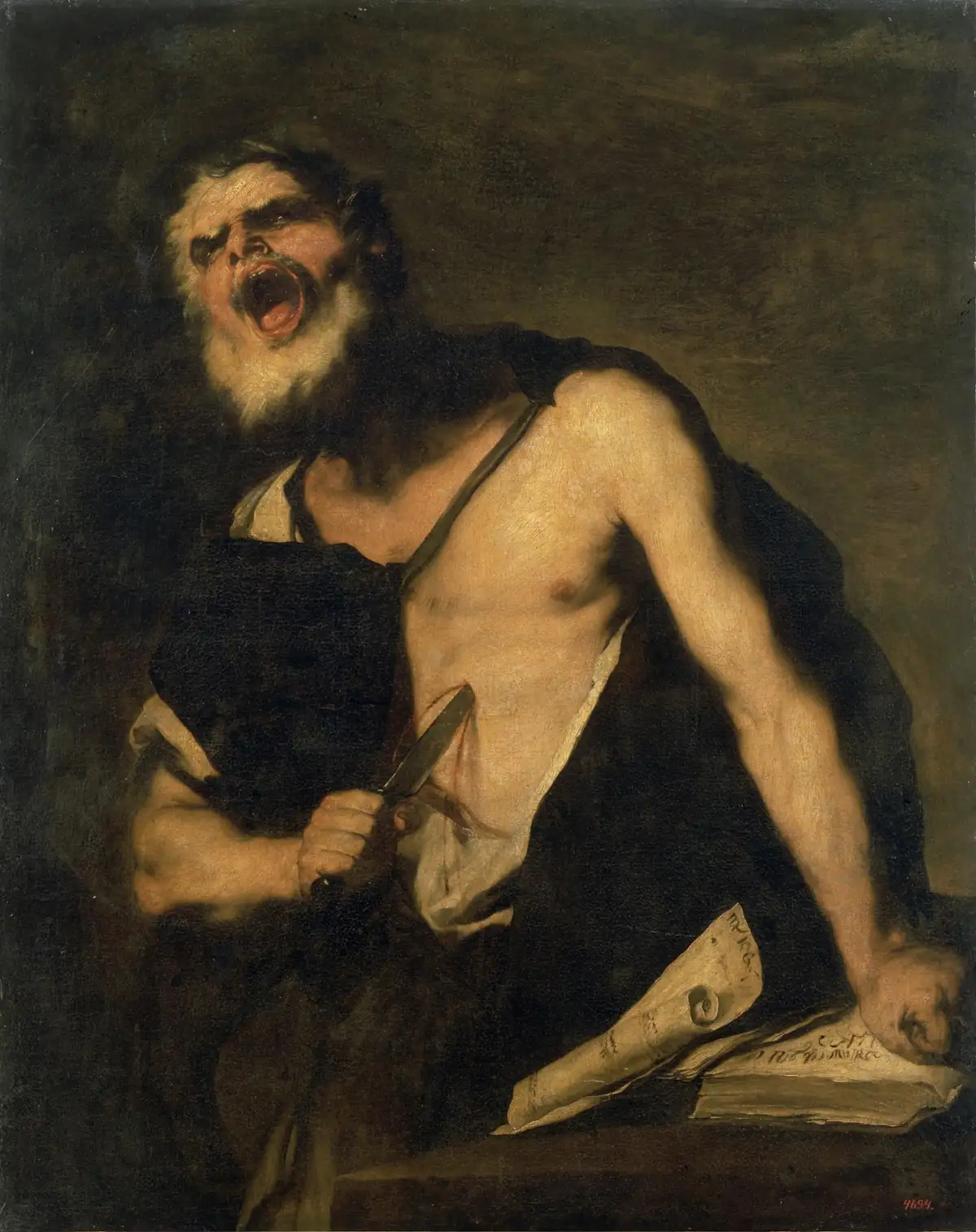
After the defeat at Thapsus in 46 BCE he was at Utica, in Africa. Plutarch says that on the last night he read Plato’s dialogue on the soul, the Phaedo, had his sword taken away and then returned, and said “Now I am my own master” when he had checked the blade. He read the book through twice, slept, and near dawn wounded himself. When a physician sewed the wound, he tore it open. The picture on this page is Luca Giordano’s Death of Cato of Utica in the Hermitage, a seventeenth-century deathbed with a book. It is not a portrait from life.
Luca Giordano, The Death of Cato of Utica, seventeenth century. State Hermitage Museum. Not a portrait from 46 BCE. Public-domain reproduction via Wikimedia Commons. Image file. Public domain. See the Commons file for the reproduction status outside the United States.
